
If you work in corporate sustainability, legal, or compliance, you already know the problem.
Regulatory authorities — the US Federal Register, the EU Official Journal, and dozens of others — publish hundreds of updates every month. Final rules. Proposed rules. Delegated acts. Enforcement actions. Each one potentially material to your organization’s disclosure obligations.
And most compliance teams find out about them weeks late, through a law firm newsletter that arrived after the comment period closed.
That’s not a workflow inconvenience. That’s governance risk.
This post covers why traditional ESG regulatory monitoring fails at scale, what a purpose-built monitoring tool looks like, and why Blume Terminal is the tool I’d recommend for compliance teams that need to close that gap — starting today, with a 14-day free trial.
Why Compliance Teams Keep Missing Material ESG Regulatory Changes
Let’s be honest about how most corporate ESG monitoring actually works.
Someone on the sustainability team subscribes to a few law firm newsletters. Maybe there’s a Google Alert set up for “CSRD updates.” The Head of ESG skims a Big Four advisory digest on Friday afternoons when they have time — which is not every Friday.
This works fine for the big, obvious regulatory moments. When the CSRD itself was adopted, everyone knew about it. When the SEC announced climate disclosure rules, it was on every compliance team’s radar.
What gets missed are the documents that follow:
- Corrigenda — corrections to previously published regulations that change a data point definition or a threshold value, published quietly in the EU Official Journal with no press release
- Delegated regulations — detailed technical rules that have the same legal force as the parent directive but receive a fraction of the news coverage
- Proposed rules with 30-day comment windows — by the time a law firm writes about it, the window to influence the outcome has closed
- Enforcement actions and agency guidance — that signal shifting enforcement priorities before they become formal rules
The consequence of missing these isn’t abstract. A final rule published today with a 90-day compliance window that you discover on day 75 is a genuine crisis for a public company.
What Good ESG Regulatory Monitoring Actually Looks Like
A proper monitoring system has four characteristics that most ad-hoc approaches lack.
It monitors primary sources, not secondary ones. The EU Official Journal and the US Federal Register are where regulations are published with legal force. Law firm newsletters, advisory digests, and news articles are interpretations of those primary sources — introduced after a delay, filtered through an editorial lens, and written for a general audience rather than your specific regulatory footprint.
It classifies by relevance to your organization. An EPA rule affecting oil refineries is not equally relevant to a retail company. A CSRD delegated act on sector-specific ESRS standards may or may not affect your industry. A good monitoring system filters the signal before it reaches your inbox — so you’re not triaging 50 documents a day to find the three that matter.
It tells you how material something is before you read it. Not every regulatory publication is a five-alarm fire. Some are informational updates. Some are final rules with immediate compliance deadlines. Knowing the difference at a glance — before you spend 45 minutes reading the full document — is the difference between a monitoring system that works and one that creates its own noise.
It delivers to your inbox without requiring you to go looking. Any system that requires a daily login, a manual search, or a designated team member to check a dashboard is one missed day away from a gap in coverage. Alerts delivered to the inbox — filtered, classified, and actionable — remove the human single point of failure.
Blume Terminal: Purpose-Built ESG Regulatory Intelligence
Blume Terminal is a regulatory intelligence platform built specifically for this problem.
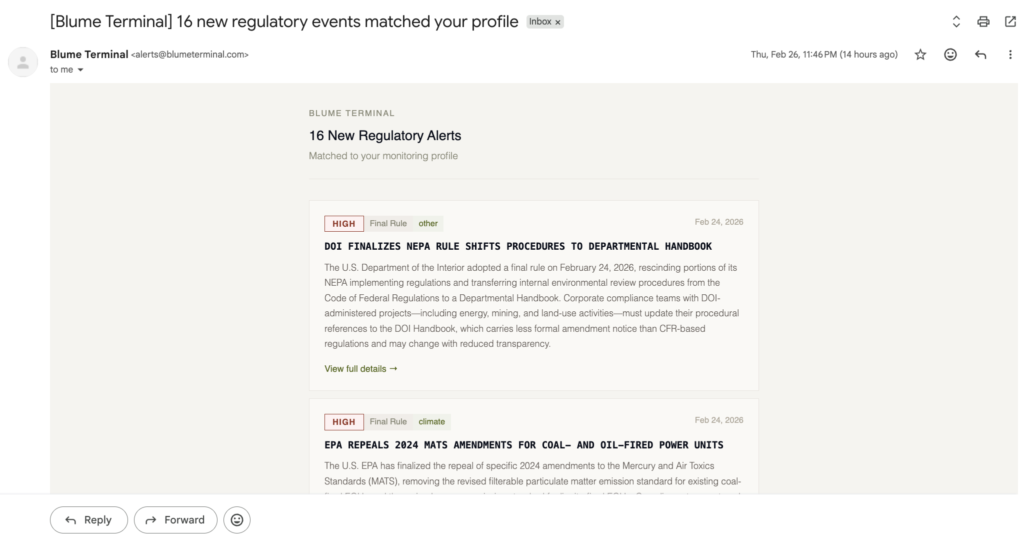
It monitors the US Federal Register and EU Official Journal continuously — every published document is ingested, run through an AI classification pipeline, and assessed for ESG relevance, materiality, affected industries, jurisdiction, and regulatory framework (CSRD, TCFD, ISSB, SEC Climate, and others).
You configure your organization’s profile once: the industries you operate in, the jurisdictions you’re exposed to, the frameworks your team monitors, and your materiality threshold. From that point forward, you receive email alerts only when a regulatory development intersects with your specific profile.
What makes it different from a Google Alert or an RSS feed
The distinction matters. A keyword alert on “CSRD” will return hundreds of documents — news articles, blog posts, commentary, academic papers, and the occasional actual regulatory publication buried somewhere in the results. You still have to triage everything manually.
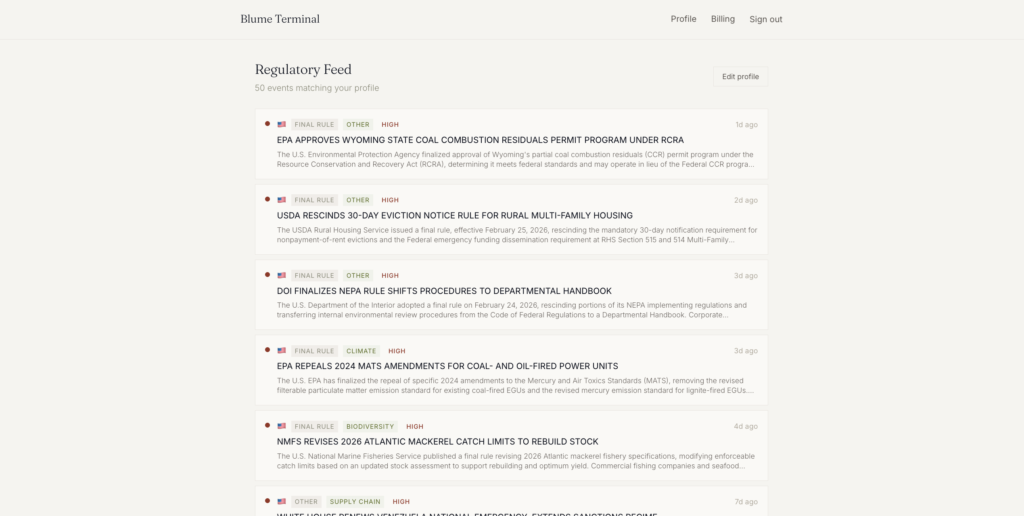
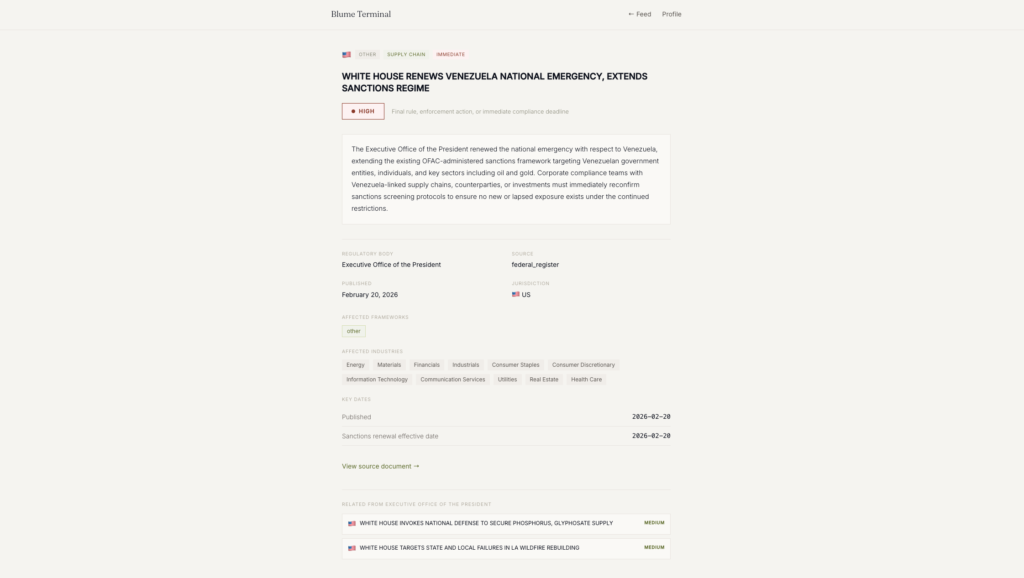
Blume Terminal ingests directly from official government sources. Every document that enters the system is assessed by AI for ESG relevance before it reaches a subscriber. Non-ESG documents are filtered out entirely. ESG-relevant documents are classified and scored — HIGH, MEDIUM, or LOW materiality — so you know within seconds whether something requires urgent attention or routine awareness.
The free Telegram feed
Before you commit to a paid plan, there’s a free option worth knowing about.
Blume Terminal runs a public Telegram channel — t.me/esgintelligence — that posts HIGH materiality ESG events daily at no cost, no signup required. It’s a useful way to see the quality of the intelligence before deciding whether the filtered, profile-matched email alerts are worth paying for.
For compliance teams that need the full filtered experience — alerts matched to your specific industries, jurisdictions, and frameworks — that’s the paid product.
Blume Terminal Pricing: What You Get
Blume Terminal offers two plans, both with a 14-day free trial (card required, cancel anytime):
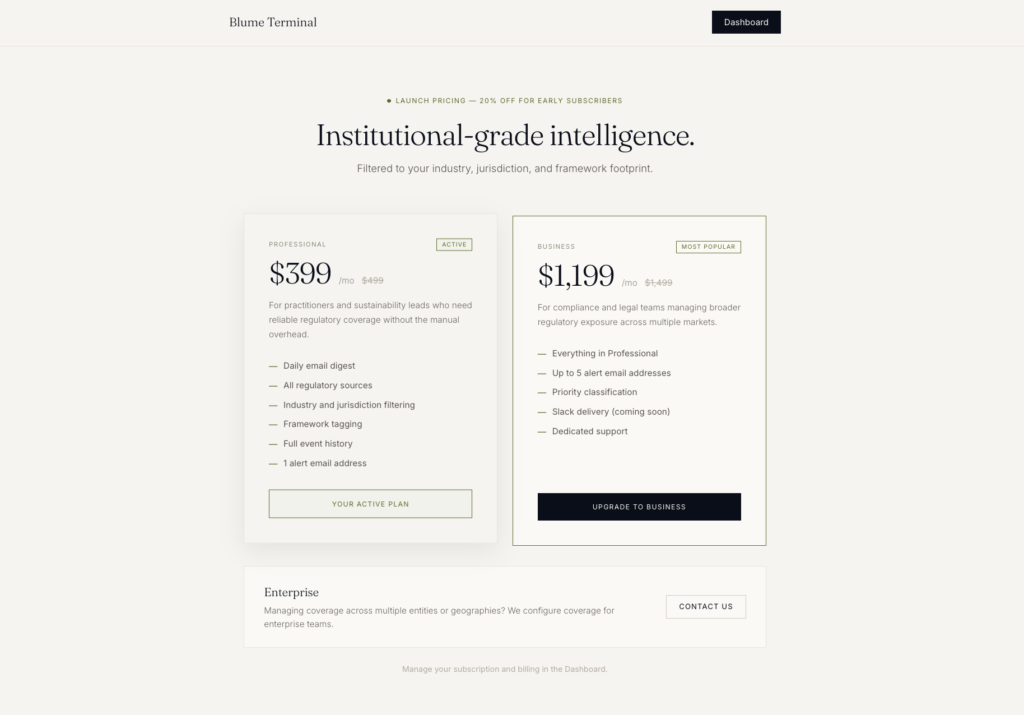
| Plan | Price | Alert Addresses | Best For |
|---|---|---|---|
| Professional | $399/month | 1 email address | Individual sustainability leads and compliance managers |
| Business | $1,199/month | Up to 5 email addresses | Compliance and legal teams managing broader regulatory exposure |
| Enterprise | Contact for pricing | Custom | Multi-entity and global coverage needs |
Current pricing reflects a 20% launch discount off standard rates — Professional is listed at $399 versus the standard $499, Business at $1,199 versus $1,499. This is launch pricing for early subscribers.
👉 Start your 14-day free trial at blumeterminal.com
Who This Is For
Blume Terminal is built for teams at mid-to-large companies where ESG regulatory compliance is a real operational concern — not a checkbox exercise.
The clearest fit is:
- Corporate sustainability managers at listed or pre-IPO companies with CSRD or SEC climate disclosure obligations
- ESG compliance leads at financial institutions managing TCFD, SFDR, or ISSB reporting requirements
- Legal counsel at industrial or manufacturing companies with LkSG, EUDR, or supply chain due diligence exposure
- Chief Sustainability Officers at companies operating across multiple jurisdictions who need comprehensive coverage without building a monitoring function from scratch
If your team is currently relying on law firm newsletters, weekly advisory digests, or a shared Google Alert to stay current on ESG regulation — this is the upgrade.
What It Won’t Do
Worth being direct about the limitations.
Blume Terminal is a regulatory intelligence and alerting platform — it tells you what has been published and whether it’s material to your organization. It is not an ESG reporting tool, a data collection platform, or a CSRD compliance management system. It doesn’t help you collect Scope 1–3 emissions data, prepare audit-ready disclosures, or manage your ESRS data points.
Think of it as the early warning layer that sits upstream of your reporting workflow. It tells you what’s changing in the regulatory environment. What you do with that intelligence — internally, with counsel, or through a reporting platform — is up to your team.
The Bottom Line
ESG regulation is not slowing down. CSRD is producing a continuous stream of implementing acts and delegated regulations. The Federal Register publishes ESG-relevant documents every business day. The EU Official Journal is adding to the compliance burden for any company with European exposure.
Most compliance teams are monitoring this landscape with tools that weren’t built for it — keyword alerts, newsletter subscriptions, and hope. The teams that will consistently stay ahead of regulatory exposure are the ones that have a systematic, automated process that monitors primary sources, classifies what matters, and delivers filtered intelligence before deadlines arrive.
Blume Terminal is the most straightforward way to build that process — starting with a free trial that costs nothing to test.
👉 Try Blume Terminal free for 14 days — no commitment
Or subscribe to the free public feed first: t.me/esgintelligence
Disclosure: This post was written by the team behind Blume Terminal. We built it because we couldn’t find a tool that solved this problem the way we wanted it solved. The 14-day free trial is real — no credit card games, cancel anytime.